


If you’ve ever asked, “Should I use synthetic oil if I only drive short distances?”, you are not overthinking it. It is a smart question. And for many drivers, the answer matters more than it seems.
Short trips look easy on a car. You drive a few minutes, park, and move on with your day. It feels light. It feels harmless. But engines do not always see it that way.
When you only drive short distances, your engine may not stay hot long enough. That matters because heat helps burn off moisture and small amounts of unburned fuel that can collect in the oil. When that does not happen often enough, the oil can lose some of its strength over time.
That is why this kind of driving is often treated as tougher than people expect. If your routine is mostly short errands, traffic, school runs, or quick trips across town, your oil may be working harder than your mileage suggests.
Before you choose, you can also read our guide to choosing the right oil filter and browse our engine oil collection. For wider maintenance guidance, AAA’s engine oil guide is also useful.
Why Short Trips Can Be Harder on Oil Than Long Drives

It sounds backwards at first. A longer drive feels like more work for the car. But short trips often create a different kind of stress.
Think of two drivers.
One person drives for 40 minutes on the highway. The engine warms up, settles in, and runs at a steady pace.
The other person starts the car six times a day for quick runs. Five minutes here. Ten minutes there. Traffic lights. Idling. Then the engine shuts off and cools down again.
In many cases, the second pattern is harder on the oil.
Cold starts happen again and again

Each time you start the engine, oil needs a moment to move through the system. That early phase matters. Now repeat that several times a day and the stress builds in a quiet way.
It is a bit like getting up from a chair and lifting something heavy before your body is ready. Once may not matter much. But repeat it often enough and the strain starts to show.
And because your drive is short, the engine may not stay hot long enough to fully clear out moisture and fuel from the oil. Over time, that can reduce how well the oil protects moving parts.
For more detailed tips, check out Dub Source’s Oil Filter Collection.
Low Mileage Does Not Always Mean Low Stress
This is where many drivers get caught out. They think, “I hardly drive, so my oil should still be fine.”
But the real issue is not only distance. It is the pattern. Stop. Start. Warm up a little. Cool down again. Repeat.
That routine can age oil faster than people expect, especially in traffic or hot city conditions.
City use adds another layer.
Short-distance driving often comes with slow traffic, red lights, short waits, and limited airflow. So even though the trip is short, the oil still deals with uneven heat and repeated stress.
That is one reason quick city runs can be tougher on oil than a longer, smoother drive on open roads.
So, Should You Use Synthetic Oil?
In many cases, yes. Synthetic oil often makes more sense when most of your driving is short and repeated.
But there is one rule that comes before everything else.
Check your owner’s manual first.
Your car’s manual tells you the correct oil grade and the correct specification. That matters more than opinions, trends, or brand claims. If the manual requires synthetic oil, that settles it. Use synthetic oil.
If the manual allows more than one type, then your driving style becomes a big part of the decision. And this is where synthetic oil often has the advantage.
Why Synthetic Oil Can Make More Sense for Short-Distance Driving
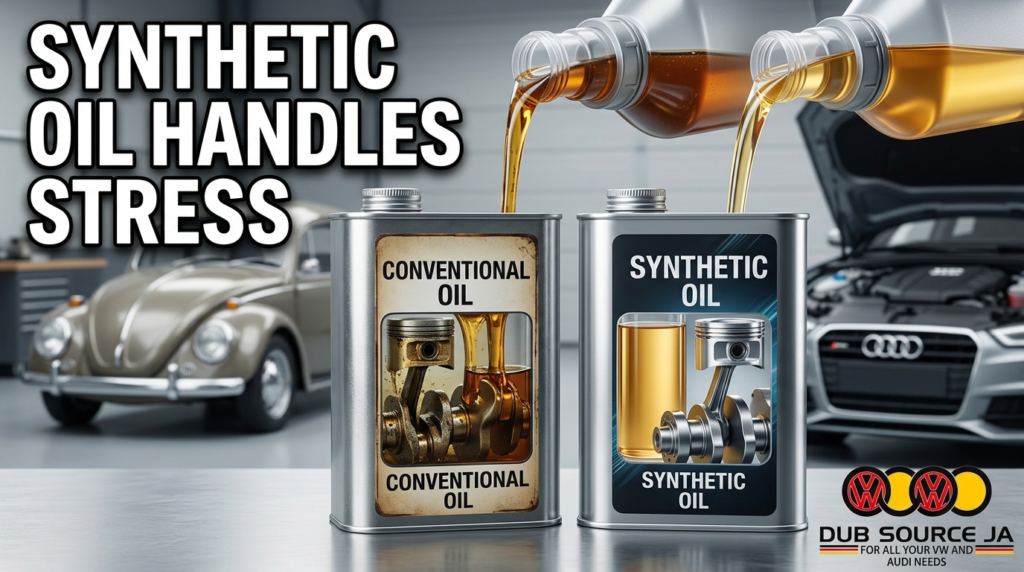
Synthetic oil is not magic. It does not cancel poor maintenance. It does not fix the wrong oil interval. But it often handles difficult driving conditions with more stability.
That extra margin can matter when your engine keeps going through short, incomplete warm-up cycles.
- It Usually Resists Breakdown Better
Short trips create an uneven rhythm for oil. The engine warms up a little, then cools down. Then it does it again.
Synthetic oil tends to hold its performance better under that kind of stress. That does not mean it lasts forever. It means it may stay more stable when conditions are not ideal.
Think of it like a better-quality fabric. Both shirts may look the same on day one. But one keeps its shape after repeated wear and washing. The other starts to fade and sag much sooner.
- It Flows Well When the Engine First Starts
The first few moments after start-up are important. Oil needs to move quickly and coat the parts that need protection.
If you start your car once and drive for an hour, that start-up phase only happens once. If you start your car six times for short trips, that phase matters six times.
That repeated start-up pattern is one reason many drivers who do short runs lean toward synthetic oil.
- It Often Suits Modern Engines Better
If you drive a VW or Audi, this matters even more.
Modern engines are not as forgiving as older ones. They often run hotter. They may use turbochargers. They usually depend on exact oil standards, not just a basic grade.
So the real question is not simply synthetic versus conventional. The real question is whether the oil matches what your engine was built to use.
If your manual calls for a certain approval, follow that first. Then choose a quality oil that meets it.
When Synthetic Oil Is Usually Worth It
Here is a simple way to look at it.
Synthetic oil is often worth choosing if most of your driving looks like this:
- Short trips through town
- Daily stop-and-go traffic
- School runs and quick errands
- Frequent engine starts throughout the day
- A modern or turbocharged engine
- A manual that already recommends synthetic oil
In these cases, synthetic oil may give you more breathing room. Not freedom to neglect maintenance. Just better support for the way you actually drive.
When Conventional Oil May Still Be Enough
To keep this balanced, conventional oil still has a place.
It may still be fine if:
- Your owner’s manual allows it
- Your engine is older and simpler
- You do regular longer drives that fully warm the engine
- You stay strict with service intervals
Still, if your routine is mostly short trips, conventional oil gives you less margin for error. That is the trade-off.
A Quick Real-Life Example
Picture a driver in Kingston who uses the car for daily errands. A run to the shop. A school pickup. A short trip to work. A stop in traffic on the way back home.
The car does not feel overworked. The engine sounds normal. Nothing seems wrong.
But week after week, the oil keeps dealing with the same pattern. Start cold. Warm a little. Stop. Cool down. Start again.
That is how oil can wear quietly. Not through drama. Through repetition.
And that is why synthetic oil often makes sense for drivers who think, “I barely drive.” Sometimes that exact habit is the reason to take oil choice more seriously.
A Simple Way to Decide
If you want the short version, use this guide.
Go with synthetic oil if:
- You mostly drive short distances
- You sit in traffic often
- Your engine is modern or turbocharged
- You want stronger protection in daily stop-start use
- Your manual recommends or requires it
Conventional oil may be enough if:
- You do longer drives on a regular basis
- Your engine is older and less demanding
- Your manual allows it
- You are very consistent with maintenance
If you are stuck between the two, it often makes sense to lean toward the safer option, especially if your driving pattern is hard on oil.
A Smarter Oil Routine for Short-Distance Drivers

Oil choice matters. But routine matters too.
A good oil cannot fully help if the rest of the maintenance is careless. And a strong filter matters more than many drivers realise.
What to Do:
- Follow the exact oil grade and approval in your owner’s manual
- Use a quality oil filter, not just the cheapest option
- Change oil based on time as well as mileage
- Take the car on a longer drive now and then when practical
- Pay attention to how the engine sounds, feels, and responds
What to Avoid:
- Delaying oil changes because the mileage is low
- Choosing oil based only on price
- Ignoring the filter during service
- Using the wrong grade or approval
Oil and filter work as a pair. If one is weak, the whole system loses something.
People Also Ask
- Does short-distance driving wear out oil faster?
In many cases, yes. Short trips may not keep the engine hot long enough to burn off moisture and fuel. That can put more stress on the oil over time. - Is synthetic oil better for stop-and-go driving?
Often, yes. Synthetic oil usually handles changing conditions, repeated starts, and traffic stress better than conventional oil. - Do I still need regular oil changes if I barely drive?
Yes. Oil breaks down with time as well as mileage. And short trips can increase contamination even when the odometer does not move much. - Can I switch from conventional oil to synthetic?
Usually yes, as long as the synthetic oil matches the grade and approval your vehicle requires. The manual should guide that decision. - Is synthetic oil worth it for older cars?
Sometimes. It depends on the engine design, condition, and what the manufacturer allows. Older does not always mean synthetic is unnecessary. But it is not automatic either.
Take the Next Step
So, should you use synthetic oil if you only drive short distances?
In many real-world cases, yes.
Short trips may look gentle, but they can be surprisingly tough on oil. The stress builds slowly. Quietly. In a way many drivers do not notice until later.
Synthetic oil does not remove that stress. But it often handles it better.
The best move is simple. Understand how you actually drive. Match your oil to that reality. Then stay consistent with maintenance.
If you are not sure what fits your VW or Audi best, take a look at our engine oil collection or read our oil filter guide. If you still want a second opinion, contact Dub Source for clear, practical help.