Here’s the thing: you can replace parts safely in Kingston without paying dealership-level prices. But you need a process. Most people lose money in this market for one of three reasons:
- They buy a part before they confirm the real problem.
- They rely on vague vehicle details instead of exact matching.
- They purchase from sellers who can’t stand behind the part.
This guide gives you a professional, repeatable framework you can use every time you need to replace a component. It’s not written for mechanics only. It’s written for everyday drivers who want fewer breakdowns, fewer repeat repairs, and more control over what they’re spending.
The True Cost of “Cheap” Parts in Kingston
“Cheap parts” in Kingston usually means one of these:
- Low-grade new aftermarket parts with poor tolerances and weaker materials
- Foreign-used parts with unknown wear history (sometimes excellent, sometimes near end-of-life)
- Counterfeit parts packaged to look like trusted brands
The problem is not that affordable parts exist. The problem is that inconsistent parts exist, and the market doesn’t always make it obvious which category you’re buying.
A cheap part can cost you more in four hidden ways:
1) You pay labour twice
Even if the part is inexpensive, the labour to install it is not. When a part fails early, you don’t just buy a replacement. You pay removal and installation again.
2) It damages adjacent components
Poor brake pads can score rotors. Weak suspension joints can create uneven tyre wear. Low-quality sensors can cause drivability issues that stress other systems.
3) It creates safety risk
Certain systems don’t give you time to “wait and see.” Brakes, steering, suspension joints, wheel bearings, tyres, and critical engine timing components are not areas to gamble.
4) It creates downtime
A vehicle that is repeatedly in the shop costs you in time, missed work, ride-share expenses, and the stress of unreliable transport.
A professional approach isn’t about buying the most expensive part. It’s about buying the right part once.
How the Kingston Parts Market Actually Works
Most buyers interact with three tiers:
Tier A: Dealership / authorised channels
You usually get correct fitment, documented part numbers, and warranty clarity. But pricing can be high, and availability can still be an issue depending on model.
Tier B: Reputable new aftermarket retailers
This is often the best value lane if you know what to buy. Many parts sold here range from OEM-equivalent quality to low-end “will fit” options. Your job is to distinguish which is which.
Tier C: Foreign-used market
Kingston’s foreign-used market can be excellent for specific categories, especially body and trim. But it requires inspection discipline and a warranty conversation, not blind trust.
Your goal is not to pick a tier and stay there. Your goal is to match the sourcing tier to the part category.
The Professional Framework: Replace Parts Without Guesswork
The biggest upgrade you can make as a vehicle owner is to stop treating repairs as reaction and start treating them as process.
Step 1: Confirm the real problem before you shop
Never buy a part because of a “feeling.” Symptoms are not diagnoses. A vibration could be tyres, alignment, wheel bearings, worn bushings, a damaged rim, or a drivetrain issue. A warning light could be a sensor, a wiring issue, a vacuum leak, or a mechanical problem upstream.
If your check engine light is on, start with a scan. It’s a baseline, not a final answer. The California Air Resources Board notes OBD-II is required on 1996+ gasoline vehicles and 1997+ diesels in that regulatory context, which is why scan diagnostics are so common on modern cars.
California Air Resources Board
A good rule:
- Use scan + inspection, not scan alone.
- Ask for the code, ask for the probable causes, and then verify.
If it’s brakes, demand a visual inspection.
If it’s suspension, demand that the worn movement or leak is shown.
If it’s overheating, inspect coolant condition, leaks, radiator fan function, thermostat behaviour, and hoses before ordering anything.
Step 2: Collect accurate vehicle details (not just the model name)
In Kingston, “Toyota Corolla” is not enough. “Honda Fit” is not enough. Even the same model year can have variations.
Write these down before you call any parts shop:
- VIN or chassis number
- Exact year of manufacture (and sometimes month)
- Engine size and engine code (if available)
- Transmission type (automatic, CVT, manual)
- Model code (especially for JDM imports)
This is the difference between “it should work” and “it matches.”
Step 3: Match the part number whenever possible
Part numbers cut through confusion. They reduce the risk of buying the wrong component and discovering it only after your mechanic has already removed the original.
If the old part is available, bring it for side-by-side comparison:
- Mounting points
- Connector shape and pin layout
- Physical dimensions
- Hose or line connections
- Sensor body style and bracket design
If the seller cannot provide a part number or refuses to discuss it, that’s not a normal inconvenience. That’s a quality signal.
New vs Used vs Aftermarket: Make the Decision Like a Pro
This is where most drivers either save money intelligently or lose money repeatedly.
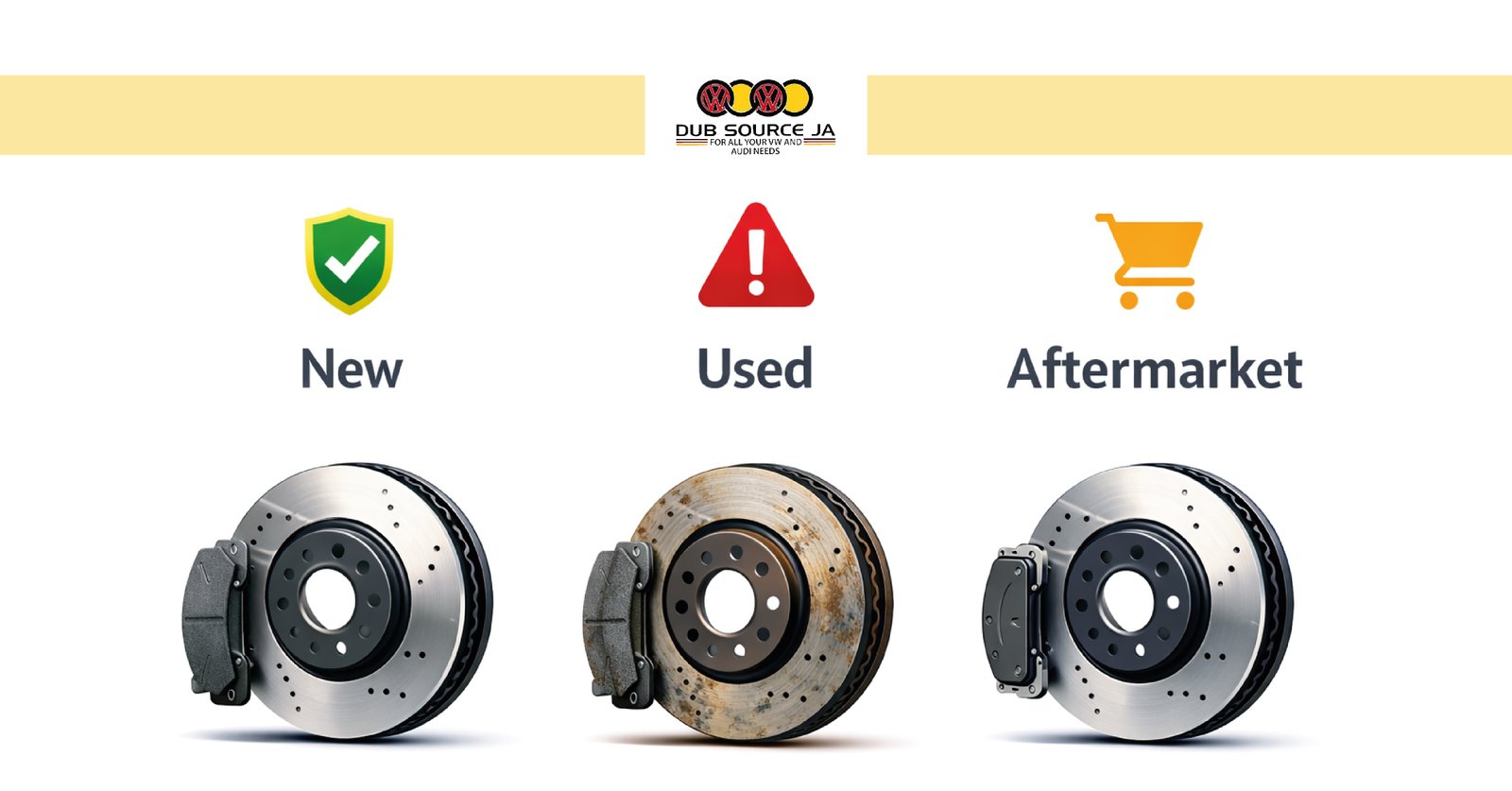
Parts that are often safe to buy foreign-used
Foreign-used can be a strong choice for parts where:
- wear is minimal,
- failure is not safety-catastrophic, and
- condition can be visually assessed.
Examples:
- Body panels: doors, fenders, bumpers (check for rust and repairs)
- Mirrors and trim pieces
- Interior switches, window regulators, handles
- Some lighting assemblies (check moisture damage and cracks)
Some mechanical items can be foreign-used if and only if:
- the vendor tests it,
- you get a short written warranty, and
- you inspect carefully.
Examples:
- alternators
- starters
- AC compressors (higher risk, requires stronger warranty conversation)
Parts that should usually be new (or OEM-equivalent new)
These parts have defined wear life, and used versions are often near end-of-life with no reliable way to confirm remaining lifespan.
Examples:
- brake pads and brake shoes
- rotors (unless you’re buying new rotors specifically)
- suspension joints: ball joints, tie rod ends, rack ends
- wheel bearings
- engine sensors that impact fuel/air timing in critical ways
- timing belt/chain components and tensioners
- engine mounts (case-by-case, but usually better new if worn)
Parts you should treat as non-negotiable safety items
If these fail, the consequences are immediate and dangerous.
- steering components
- core braking system parts
- worn suspension joints that affect stability
- tyres (never play games here)
If money is tight, the safer approach is usually to:
- buy fewer things at once,
- phase repairs,
- but keep safety-critical items in the “new or OEM-equivalent” category.
How to Buy OEM-Equivalent Parts Without Getting Burned
A lot of dealership parts are produced by major global suppliers. The same supplier may sell the same part under their own brand at a lower price. That’s where the smart savings are.
But Kingston also has a reality: packaging can be faked, and “brand-name” can be imitated.
So your process becomes:
- Identify trusted OEM-equivalent brands for that category
- Buy from sellers with consistent reputation and clear warranty terms
- Inspect packaging quality, serial markings, and the part itself
- Avoid “too good to be true” pricing
If a price is dramatically lower than every other competitor, treat it as suspicious until proven otherwise.
The Foreign-Used Market: How to Shop It Without Regret
Foreign-used is not automatically bad. In Jamaica it’s a major pillar of vehicle maintenance. The problem is that many buyers treat it like a lottery instead of a controlled purchase.
Here’s how to shop foreign-used like a professional:
Ask the right questions (short, direct, specific)
- What vehicle did it come from?
- Do you have the model code or chassis reference?
- Can you show me the unit before purchase?
- What is the exchange policy and time window?
- Is the warranty written on the receipt?
If they can’t answer anything clearly, walk away. That’s not rudeness. That’s risk management.
Inspect what matters
- Look for cracks, repaired welds, bent brackets
- Check rubber for dry rot and hardening
- Check connectors for broken clips or corrosion
- Check mounting holes for elongation or stress marks
- Check for signs of water exposure (especially for electronics)
Avoid “pressure sales” energy
If the seller is pushing urgency, refusing inspection, or discouraging questions, treat that as a signal. The best sellers in any market are usually confident enough to let the product stand up to inspection.
Importing Parts Into Jamaica: When It’s Worth It and How to Do It Right
Importing can be the difference between overpaying locally and getting the correct part at a fair total cost. But importing is only “cheaper” when you count everything properly.
The Jamaica Customs Agency provides tools like “What’s My Duty” and a duty estimator to help you estimate duties and taxes before import, which is exactly what you want if you’re trying to avoid surprise costs at clearance.
Jamaica Customs Agency
Before you import, calculate:
- part price
- shipping cost (weight and size matter)
- duties and taxes estimate
- clearance time and delay risk
- return risk (often not practical)
When importing makes the most sense
- The part is hard to find locally
- The local markup is extreme
- You need a specific OEM part number match
- You want to control quality and brand authenticity
When importing may not be worth it
- Heavy parts where shipping dominates the cost (rotors, flywheels, large suspension components)
- low-cost parts where duty and freight erase savings
- urgent repairs where the vehicle can’t be down
The accuracy rule: verify twice, order once
If you import the wrong part, you often can’t recover the cost. Not because the seller won’t accept returns, but because the shipping back and forth becomes irrational.
To reduce that risk:
- confirm part numbers
- confirm model code compatibility
- confirm left vs right orientation
- confirm connector version
- confirm engine variant (especially for sensors and mounts)
Counterfeit and Low-Quality Parts: How to Spot Trouble Early
Not every failure is counterfeit. Some parts are simply low-grade. But the buying signals are often similar.
Warning signs that should make you pause
- price dramatically lower than normal market range
- vendor unwilling to discuss warranty or exchange
- vague answers like “it works for all”
- packaging that looks low quality or inconsistent
- missing brand marks or strange spelling
Quick inspection habits that help
- Compare the weight and feel to the old part
- Inspect machining finish: rough edges and uneven casting are common on cheap units
- Check rubber components for stiffness and cracking
- Check electrical connectors for secure pins and proper clip design
- Check part symmetry and bracket alignment
If you’re not confident, bring the part to your mechanic before installation. A five-minute check can save a full labour charge.
Consumer Protection: Your Rights in Jamaica and How to Use Them Practically
Most people don’t use consumer protection tools because they assume it’s complicated. But the real issue is that they don’t keep records.
In Jamaica, the Consumer Affairs Commission (CAC) provides a formal complaint route when a matter isn’t resolved directly with the vendor.
Consumer Affairs Commission (File a Complaint)
In simple terms: if you bought a part that was misrepresented or a warranty isn’t being honoured, you should be able to escalate with documentation.
Also, the Bureau of Standards Jamaica (BSJ) has a role in inspections and investigations in the marketplace and at ports of entry, which matters in the broader quality and standards ecosystem.
Bureau of Standards Jamaica (BSJ)
What you must keep (every time)
- Receipt with date, vendor name, and part description
- Any written warranty terms
- Messages or invoice confirmations (WhatsApp, email)
- Mechanic invoice (sometimes required for warranty claims)
The professional approach to disputes
- Contact the vendor calmly with documentation
- Give them one clear opportunity to resolve
- If refused and you believe you’re within rights, escalate using CAC’s complaint channel
here.
Even if you never escalate, the habit of record-keeping changes how vendors treat you.
The Safety Checklist You Should Use Every Single Time
This is the part that makes your results repeatable.
Phase 1: Before you buy anything
- Confirm diagnosis (scan + physical inspection when relevant)
- Record full vehicle details (VIN/chassis, model code, engine, transmission)
- Confirm exact part number where possible
- Decide sourcing category: new, OEM-equivalent new, or foreign-used
- Compare at least two sellers for price and warranty terms
Phase 2: At the counter or on pickup
- Inspect the part physically
- Match connectors, mounting points, and dimensions
- Confirm warranty duration and exchange conditions
- Ensure the receipt clearly states the purchase and terms
Phase 3: After installation
- Ask your mechanic to keep the old part for verification
- Test drive in controlled conditions
- Re-check within a few days for leaks, loosening, noise, or warning lights
- If something feels off, stop and re-check immediately
The worst habit is “install and hope.” A professional always validates.
Real-World Kingston Scenarios That Show Why Process Matters
cheap brake pad trap
A driver buys the lowest-priced pads available because “pads are pads.” The pads wear quickly, create noise, and damage the rotors. Now the driver replaces pads again and adds rotor cost and labour.
The lesson: friction material quality matters, and brakes are not the place to bargain-hunt blindly.
wrong sensor spiral
A driver buys a sensor because the check engine light is on and the code points to a system. The sensor is replaced, but the light remains because the root cause was wiring damage or a leak.
The lesson: codes guide diagnosis; they don’t replace it.
smart foreign-used purchase
A driver needs a mirror or a door handle. Foreign-used is a good fit: low safety risk, easy inspection, and typically strong cost savings.
The lesson: foreign-used is powerful when used for the right categories.
Importing done correctly
A driver needs a specific part that local shops can’t confirm by part number. They import based on exact matching and duty estimation, then install once.
The lesson: importing is best when it reduces uncertainty, not when it’s simply cheaper upfront. Jamaica Customs’ duty estimator tools exist for exactly this planning purpose.
Jamaica Customs Agency
A Practical Script: What to Say to Parts Sellers (So You Get Better Answers)
Most people call a parts shop and ask:
“Do you have part for Toyota Axio?”
That question invites guessing.
Instead, use a short script that forces accuracy:
- “I have the chassis number and model code. I need an exact match.”
- “Can you confirm the part number on your item?”
- “What is the exchange period and does it go on the receipt?”
- “Can I inspect connectors and mounting points before purchase?”
You’re not being difficult. You’re preventing the normal mistakes that cost drivers money.
Quick Reference: What to Buy New vs Foreign-Used
Use this as a practical rule set:
Usually safe foreign-used (inspect carefully)
- body panels, mirrors, trim
- interior components
- some alternators/starters (only with test + written exchange)
Usually better new / OEM-equivalent
- brake pads, rotors
- wheel bearings
- suspension joints and bushings
- engine sensors (especially critical ones)
- timing components
Treat as non-negotiable safety-critical
- steering links and ends
- core braking system
- stability-critical suspension parts
If you follow this consistently, you’ll stop paying twice.
The Core Principle That Keeps You Safe and Saves You Money
If you want one rule that ties the whole system together, it’s this:
Confirm the problem, match the part exactly, and buy with warranty clarity.
That is how you operate in Kingston without dealership dependency and without falling into the “cheap parts” trap.