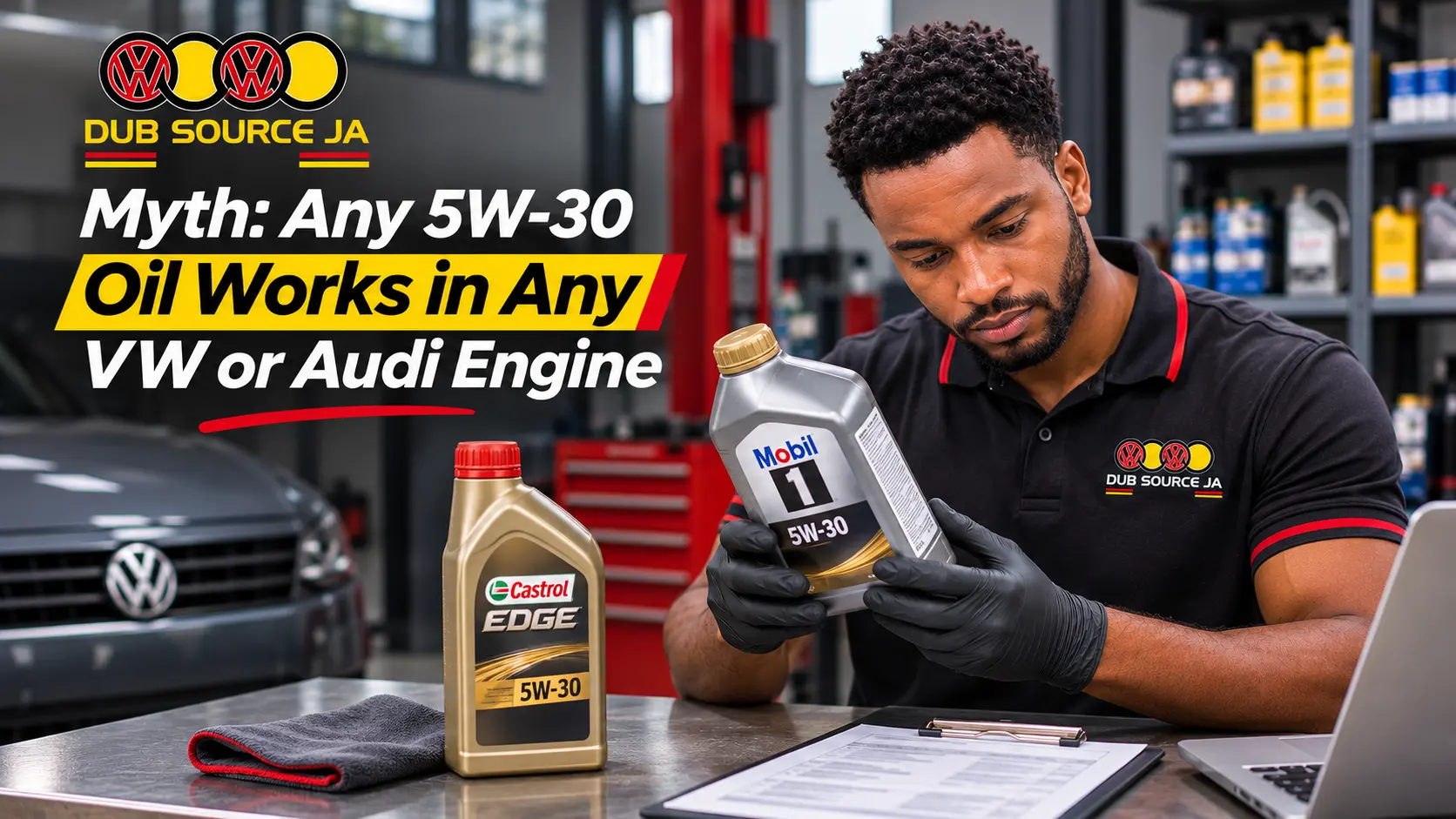
Myth: any 5W-30 oil works in any VW or Audi engine. It does not. 5W-30 describes how thick or thin an oil is at set temperatures. It does not tell you whether that oil meets your engine’s required VW approval. Two bottles can show the same grade yet meet different standards. One may be right for your Golf, while the other is not approved for it. Check the owner’s manual, the exact engine, and the VW specification on the oil label before you buy. This guide shows you what to look for and why it matters.
Why Choosing Engine Oil by 5W-30 Alone Can Cost You
Picture a Friday afternoon in Kingston. You’re stuck in slow traffic, the AC is running, and your VW is due for an oil change before the weekend. At the parts counter, you see three bottles marked 5W-30.
They all seem to answer the same need. One is on special. One says “fully synthetic.” The third says “European formula.” Why pay more if the number is the same?
Because the big number on the front tells only part of the story. The smaller print may be more useful than the bold label. It tells you which engine standards the oil is made to meet.
The goal is oil that fits your engine’s requirements.
What Does 5W-30 Really Tell You?
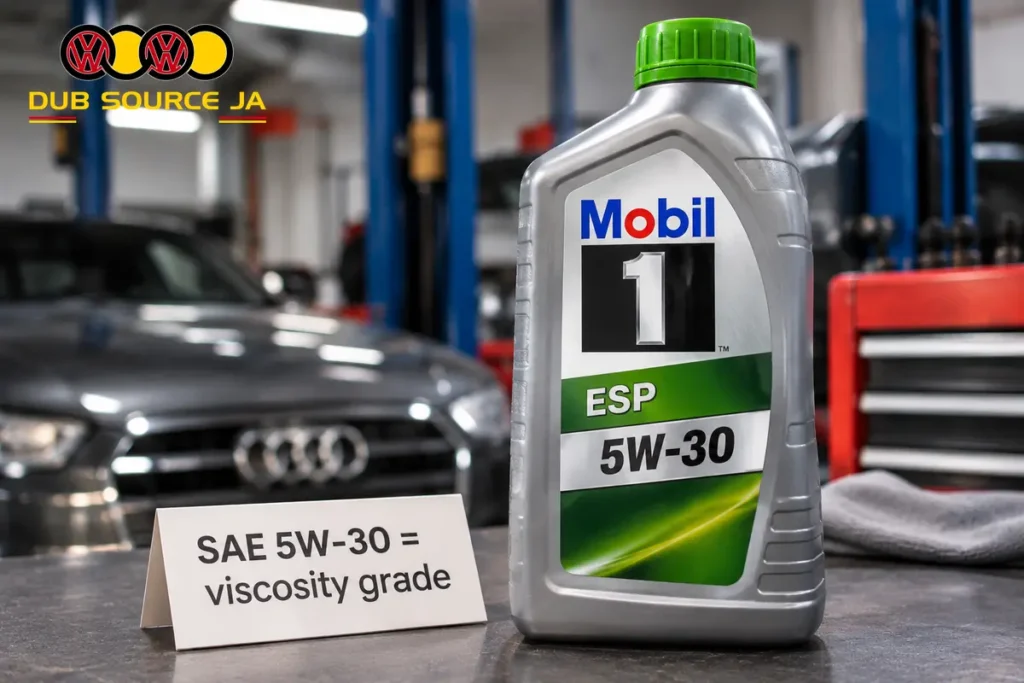
The code 5W-30 is a viscosity grade. Viscosity is the way a liquid resists flow. It helps describe how oil acts during cold starts and when the engine is hot.
What do the 5W and 30 mean?
The “5W” part is a winter-grade rating for low-temperature flow and starting performance. The “30” describes a viscosity range when the oil is hot. It does not mean the oil is only for 30-degree weather.
Think of two pairs of shoes in the same size. One is made for work on rough ground. The other is made for running. They share a size, not a purpose.
Two oils can share 5W-30 and still have different additives, approvals, and jobs. The grade helps narrow your choice.
The Missing Detail: Your Engine’s VW Oil Approval
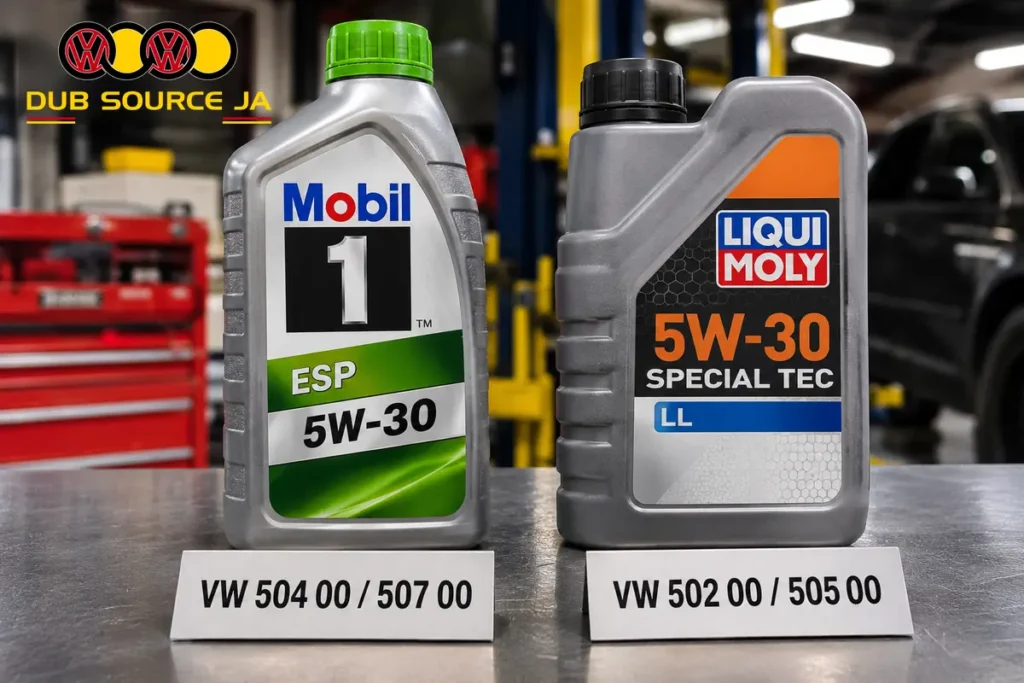
VW and Audi engines can require a maker’s oil standard. You may see numbers such as VW 502 00, VW 504 00, VW 505 01, VW 507 00, or VW 508 00/509 00.
These are performance rules for specific engines, including protection and emissions needs.
Volkswagen’s official engine oil guidance tells owners to match the VW standard in the owner’s manual to the label on the bottle. It also warns that oil without the required approval may harm the engine.
Same grade, different approval: a real example
Castrol’s Volkswagen Golf oil guide explains why engine-specific oil selection matters. Its product data sheet for Castrol EDGE 5W-30 LL lists VW 504 00/507 00. Other 5W-30 formulations may carry different manufacturer specifications, so the viscosity grade alone cannot confirm which oil is suitable for your engine.
That does not mean either bottle is bad. It means you cannot choose between them by reading 5W-30 alone. The correct choice depends on the car’s exact engine and service requirements.
These are not blanket oil picks for Jamaican cars.
Why Do Different VW and Audi Engines Need Different Oil?
A Golf, an Audi A4, and a diesel Tiguan may have very different engines. Their oil is asked to do more than make parts slippery.
Engine design and operating load
Oil helps reduce friction, move heat, and keep internal parts clean. Modern engines may use turbochargers and tight oil passages. The correct formulation matters along with the grade.
You cannot work out the approval from “turbo” or “petrol” alone. Check the manual.
Diesel particulate filters
Some diesel models have a diesel particulate filter, or DPF. Certain approved oils are made to work with the demands of these exhaust systems, including limits on ash-forming ingredients.
Using an oil without the required standard can put the engine or emissions system at risk. Do not assume every 5W-30 is suitable for a diesel with a DPF.
Newer engines may require 0W-20
Volkswagen’s LongLife IV FE guidance identifies a 0W-20 oil for approved engines requiring VW 508 00 or VW 509 00.
For those engines, picking 5W-30 just because it worked in an older VW may be wrong. Equally, 0W-20 with those approvals is not a universal upgrade for older engines.
Understanding Oil Labels: Viscosity vs VW Specifications
| What you see on the label | What it means | What it does not prove |
|---|---|---|
| SAE 5W-30 | The oil’s viscosity grade | That it meets your engine’s VW standard |
| VW 502 00 | A VW oil performance standard | That every VW petrol engine requires it |
| VW 504 00 / 507 00 | Standards found together on some approved oils | That the oil is right for all VW and Audi engines |
| VW 505 00 / 505 01 | Separate diesel-related standards that some oils carry | That they replace all other diesel oil requirements |
| VW 508 00 / 509 00 | Standards for selected engines, commonly with 0W-20 oil | That the oil suits older engines |
| “Fully synthetic” or “European formula” | A product description | Formal approval for your specific engine |
The table is a guide to reading the bottle. It is not a fitment chart. Your car’s manual or accurate vehicle-specific service data must settle the final choice. This table includes VW specifications associated with different viscosity grades, including 0W-20. It is not a list of approvals for 5W-30 oil.
Does Jamaica’s Heat Mean You Need Thicker Oil?
The bonnet feels hot after a long crawl through Half-Way Tree. Surely thicker oil must be safer?
Not by itself. The engine’s normal operating heat is not the same as the air temperature outside. Its lubrication system is designed for certain oil properties.
A hot climate does not cancel the maker’s approval. Nor does it mean every 5W-30 is too thin or that 5W-40 is always better.
If the manual offers more than one grade, follow its advice. Otherwise, ask a VW or Audi specialist to check the engine, not the weather.
What About Short Trips and Kingston Traffic?
A short journey may end before the engine has spent much time at full operating temperature. Stop-start driving and repeated idling can also make maintenance needs worth a closer look.
The VW standard still comes first. Service intervals and driving conditions come next.
If you make lots of short trips, our guide on synthetic oil for short-distance driving explains why the pattern of your journeys matters.
A proper oil service also includes the correct filter. Dub Source has an oil filter category, but filter fitment must be checked for your exact engine.

“Fully Synthetic” Is Not a Free Pass
A fully synthetic oil may be a strong product and still be the wrong one for your engine. “Premium,” “LongLife,” and “European formula” are not substitutes for reading the approval line.
Look for the maker’s stated approvals on the correct product label and data sheet. The wording can matter: a formal approval is not the same type of claim as “recommended for” or “suitable for use.”
If the label is unclear, ask for product data, not just “we always use 5W-30.”
Buy from a source you can trace. A good listing cannot prove what is in a suspect bottle.
What If the Wrong Oil Has Already Been Added?
Don’t panic because the bottle is a different brand. First, find the full product name, viscosity, and VW approval from the invoice or container.
Compare them with your car’s manual. If the oil does not meet the required standard, ask a qualified workshop what to do next. The response depends on the engine, the product, how much was added, and whether it was a top-up or a full oil change.
Some manuals permit a small emergency top-up with an alternative. That is not permission for a routine oil change. Follow your manual.
If a red oil-pressure warning appears, stop safely, switch off the engine, and seek help. Do not keep driving to see whether the warning clears.
Nine Checks Before You Buy Engine Oil
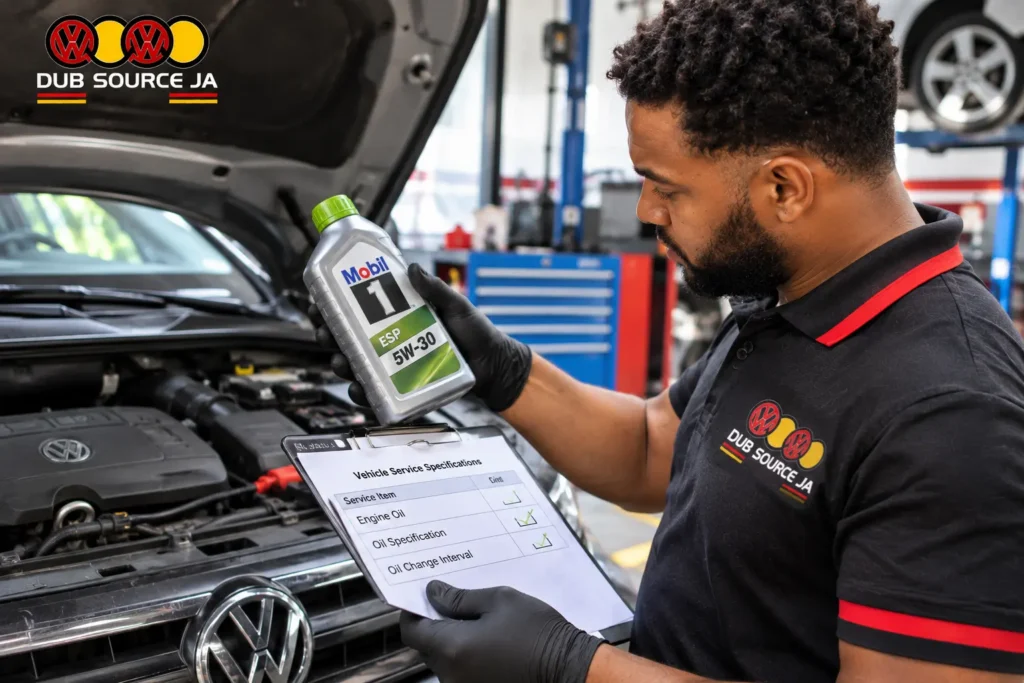
- Find your exact vehicle details. Record the model, year, engine code, and VIN if needed.
- Read the owner’s manual. Find the stated VW oil standard and viscosity options.
- Check the service plan. Note any fixed or flexible schedule requirements that apply.
- Read beyond 5W-30. Find the exact VW specification on the product label.
- Verify the approval claim. Check the current product data sheet rather than relying on a shop sign.
- Consider the engine system. Confirm any diesel DPF or other engine-specific need.
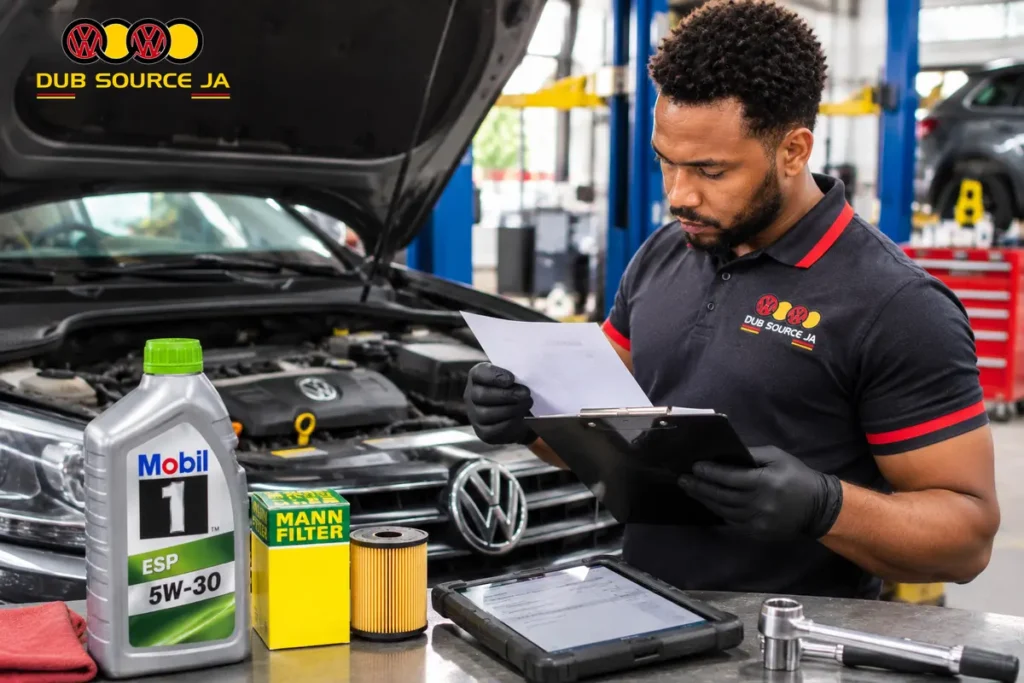
- Check the oil filter. Make sure the replacement filter fits the engine too.
- Confirm the amount and procedure. Use the correct fill quantity and service method; do not overfill.
- Keep the record. Save the product name, approval, quantity, date, and invoice.
If you need help with an oil service, Dub Source’s oil change service in Kingston is a useful starting point. Share the vehicle details so the right oil and filter can be checked before work begins.
Frequently Asked Questions
Can I put any 5W-30 oil in my Volkswagen?
No. It must meet the grade and VW specification required for your exact engine. Check the manual and bottle together.
Can I use 5W-30 oil in an Audi?
Some Audi engines use approved 5W-30 oils. Others require different grades or standards. The model name alone is not enough.
Are VW 504 00 and VW 507 00 the same thing?
No. They are separate VW oil standards. Some products carry both, but that does not make them suitable for every VW or Audi engine.
Does a diesel with a DPF need special oil?
It may require oil with a particular VW approval for its engine and emissions system. Check that standard rather than choosing by viscosity alone.
Is fully synthetic 5W-30 always the best oil?
No. Fully synthetic does not prove that the oil meets your engine’s VW approval. The correct specification matters more than a broad marketing term.
Should I switch from 5W-30 to 5W-40 because Jamaica is hot?
Not unless your vehicle’s guidance allows or calls for it. Heat outside the car is not enough reason to change the maker’s oil requirement.
Can I mix two brands of 5W-30 oil?
Different oil brands can sometimes be mixed, provided the oil meets the engine’s required VW performance specification and the vehicle manufacturer’s guidance permits it. Matching 5W-30 labels alone is not enough. If you are unsure what is already in the engine, ask a qualified workshop before topping up.
The Right VW Oil Standard Matters More Than the Big Number
A bottle can say 5W-30 in bold type and still be the wrong oil for your VW or Audi. That is the whole point of this myth.
Before you pay, look past the front label. Find the correct engine requirement, check the VW approval, and match the exact product to the car. That small step is easier than having to fix an oil mistake later.
If you need help, contact Dub Source Limited with your VW or Audi model, year, and engine details. Ask the team to confirm the suitable oil and filter before your next service. A few questions now can save a costly guess.