
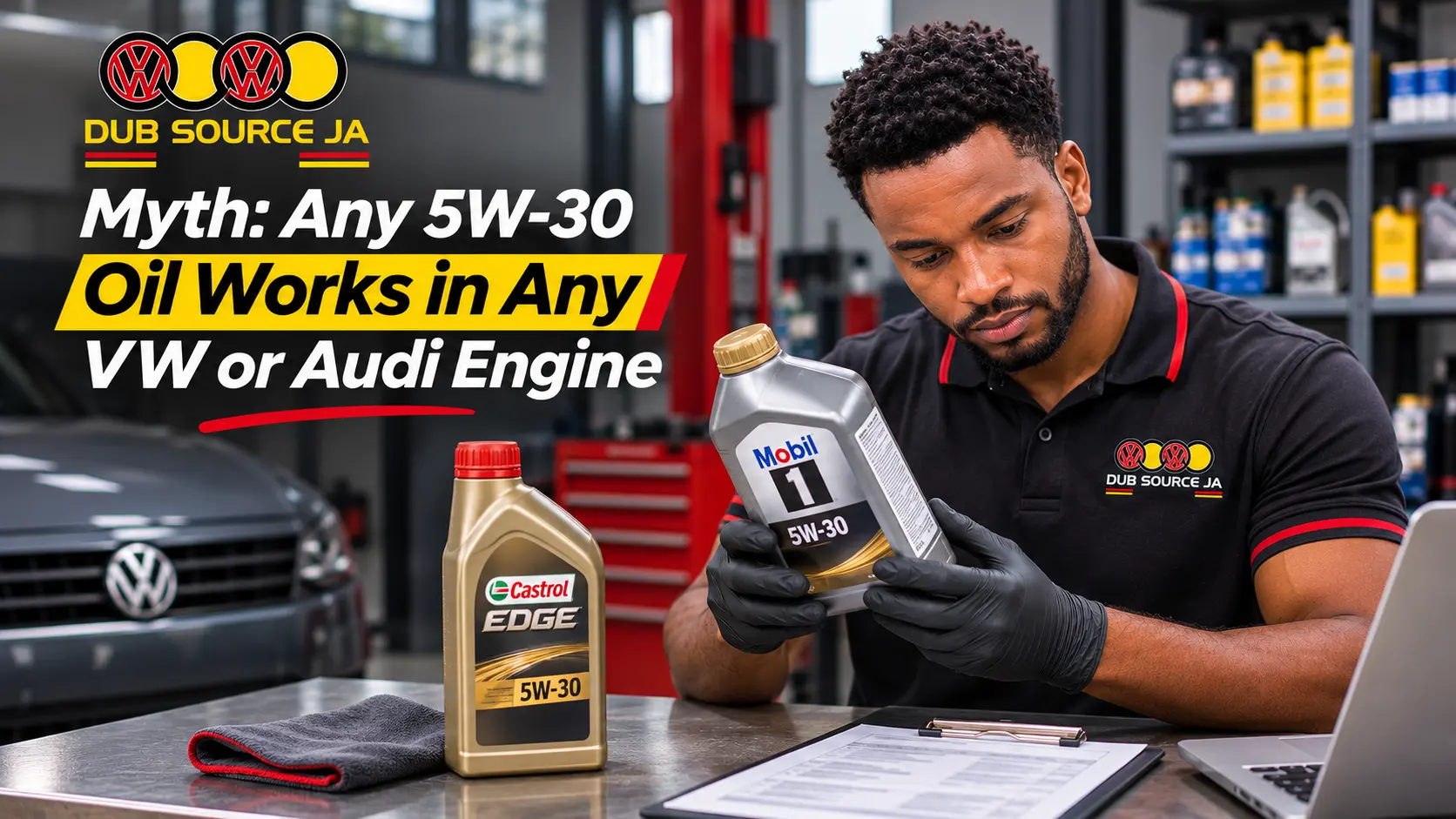
Myth: Any 5W-30 Oil Works in Any VW or Audi Engine
Myth: any 5W-30 oil works in any VW or Audi engine. It does not. 5W-30 describes how thick or thin an oil is at set temperatures. It does not tell you whether that oil meets your engine’s required VW approval. Two bottles can show the same grade yet meet different standards. One may be right for your Golf, while the other is not approved for it. Check the owner’s manual, the exact engine, and the VW specification on the oil label before you buy. This guide shows you what to look for and why it matters. Why Choosing Engine Oil by 5W-30 Alone Can Cost You Picture a Friday afternoon in Kingston. You’re stuck in slow traffic, the AC is running, and your VW is due for an oil change before the weekend. At the parts counter, you see three bottles marked 5W-30. They all seem to answer the same need. One is on special. One says “fully synthetic.” The third says “European formula.” Why pay more if the number is the same? Because the big number on the front tells only part of the story. The smaller print may be more useful than the bold label. It tells you which engine standards the oil is made to meet. The goal is oil that fits your engine’s requirements. What Does 5W-30 Really Tell You? The code 5W-30 is a viscosity grade. Viscosity is the way a liquid resists flow. It helps describe how oil acts during cold starts and when the engine is hot. What do the 5W and 30 mean? The “5W” part is a winter-grade rating for low-temperature flow and starting performance. The “30” describes a viscosity range when the oil is hot. It does not mean the oil is only for 30-degree weather. Think of two pairs of shoes in the same size. One is made for work on rough ground. The other is made for running. They share a size, not a purpose. Two oils can share 5W-30 and still have different additives, approvals, and jobs. The grade helps narrow your choice. The Missing Detail: Your Engine’s VW Oil Approval VW and Audi engines can require a maker’s oil standard. You may see numbers such as VW 502 00, VW 504 00, VW 505 01, VW 507 00, or VW 508 00/509 00. These are performance rules for specific engines, including protection and emissions needs. Volkswagen’s official engine oil guidance tells owners to match the VW standard in the owner’s manual to the label on the bottle. It also warns that oil without the required approval may harm the engine. Same grade, different approval: a real example Castrol’s Volkswagen Golf oil guide explains why engine-specific oil selection matters. Its product data sheet for Castrol EDGE 5W-30 LL lists VW 504 00/507 00. Other 5W-30 formulations may carry different manufacturer specifications, so the viscosity grade alone cannot confirm which oil is suitable for your engine. That does not mean either bottle is bad. It means you cannot choose between them by reading 5W-30 alone. The correct choice depends on the car’s exact engine and service requirements. These are not blanket oil picks for Jamaican cars. Why Do Different VW and Audi Engines Need Different Oil? A Golf, an Audi A4, and a diesel Tiguan may have very different engines. Their oil is asked to do more than make parts slippery. Engine design and operating load Oil helps reduce friction, move heat, and keep internal parts clean. Modern engines may use turbochargers and tight oil passages. The correct formulation matters along with the grade. You cannot work out the approval from “turbo” or “petrol” alone. Check the manual. Diesel particulate filters Some diesel models have a diesel particulate filter, or DPF. Certain approved oils are made to work with the demands of these exhaust systems, including limits on ash-forming ingredients. Using an oil without the required standard can put the engine or emissions system at risk. Do not assume every 5W-30 is suitable for a diesel with a DPF. Newer engines may require 0W-20 Volkswagen’s LongLife IV FE guidance identifies a 0W-20 oil for approved engines requiring VW 508 00 or VW 509 00. For those engines, picking 5W-30 just because it worked in an older VW may be wrong. Equally, 0W-20 with those approvals is not a universal upgrade for older engines. Understanding Oil Labels: Viscosity vs VW Specifications What you see on the label What it means What it does not prove SAE 5W-30 The oil’s viscosity grade That it meets your engine’s VW standard VW 502 00 A VW oil performance standard That every VW petrol engine requires it VW 504 00 / 507 00 Standards found together on some approved oils That the oil is right for all VW and Audi engines VW 505 00 / 505 01 Separate diesel-related standards that some oils carry That they replace all other diesel oil requirements VW 508 00 / 509 00 Standards for selected engines, commonly with 0W-20 oil That the oil suits older engines “Fully synthetic” or “European formula” A product description Formal approval for your specific engine The table is a guide to reading the bottle. It is not a fitment chart. Your car’s manual or accurate vehicle-specific service data must settle the final choice. This table includes VW specifications associated with different viscosity grades, including 0W-20. It is not a list of approvals for 5W-30 oil. Does Jamaica’s Heat Mean You Need Thicker Oil? The bonnet feels hot after a long crawl through Half-Way Tree. Surely thicker oil must be safer? Not by itself. The engine’s normal operating heat is not the same as the air temperature outside. Its lubrication system is designed for certain oil properties. A hot climate does not cancel the maker’s approval. Nor does it mean every 5W-30 is too thin or that 5W-40 is always better. If the manual offers more than one grade, follow its advice. Otherwise, ask a VW or Audi specialist to check the
Myth: Any 5W-30 Oil Works in Any VW or Audi Engine Read More »
Oils and Fluids